Blog/Market
28 July 2026 · 8 min read
Raising a Family on the Costa del Sol: An Honest Look at the Everyday
Families arrive here having been sold a holiday and end up living something quite different, and on the whole better. The weather is the headline and the weather is real. It is not why anyone stays. What follows is the everyday: the shape of the day, the schools, the winter nobody photographs, and the one decision that determines whether the next three years are pleasant or spent in traffic.

Carlos
Architect and Founder, DIEZ
The weather is real, and better documented than you think
Every agency here repeats the same line about 320 days of sunshine, and none can say where it comes from. Start with a sourced figure instead. AEMET publishes standard climate values for the Malaga Aeropuerto station, 6155A, on the 1981 to 2010 reference period: 2,905 hours of sunshine a year, a mean temperature of 18.5 degrees C, a mean daily maximum of 23.3 degrees C and 534 mm of rain.
Those beat the slogan. It does rain here, hard and briefly, mostly November to March. The 23.3 degrees C maximum is the family figure: a year whose default is comfortable, not the sweltering one people picture.
The day is built differently, and that is the actual benefit
What families notice after a year is not the sunshine. It is that the day has a different shape. Children go outside without a negotiation about coats. Sport happens after school, outdoors, most of the year. It sounds soft, and it is what parents mention most, because it removes a friction you notice only once it is gone.
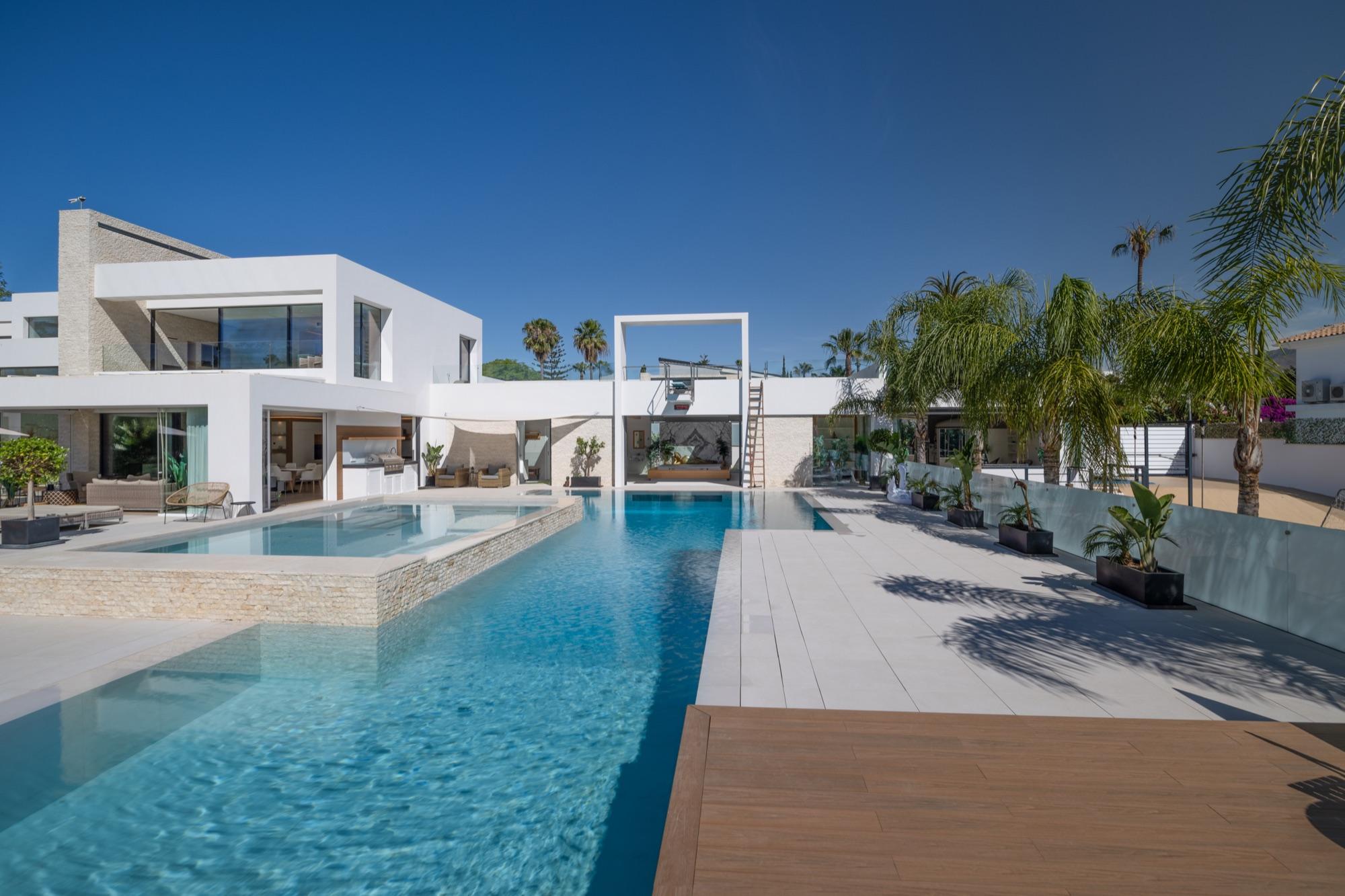
It also explains why practical questions beat glamorous ones. A pool is ordinary here, not luxurious: of the 1,531 resale homes we list, 1,401 have one. What separates one family house from another is where it sits relative to a school.
Choose the school first. Then choose the house
This is the whole page in one line. The school run is the only journey you make twice a day, every day, for a decade, and nobody tests it before buying. Families who lead with the house do it in good faith. They fall for a plot or a village, then find the school they want is across Marbella and the twenty-minute drive they tried in October takes fifty in term time. The house has not changed. The life around it has, and moving again costs more than the compromise would have.
The choice is genuinely deep for a coastline this size, which is the reason to start there rather than assume it works out. Aloha College, the English International College and Colegio Atalaya are among those serving the Marbella area. Atalaya International School serves Estepona, Marbella, San Pedro de Alcantara and Benahavis, covering Early Years through Bachillerato. We name them as existing, not as a ranking. Ranking schools over a coffee is guessing.
Pick the school, draw a sensible drive around it, then look only inside that circle. Everything else is negotiable. The school run is not.
- 1Shortlist schools first, and visit in term time, not in August when it all looks easy.
- 2Ask each school where its families live and whether it runs a bus. The bus map is a housing map.
- 3Drive the route at half past eight on a November morning, not at noon in July.
- 4Draw a realistic circle. Twenty-five minutes each way is a life. Fifty is two hours a day for ten years.
- 5Only now look at houses, inside the circle. Our full inventory filters by area.
- 6Check the village: clinic or health centre, secondary schooling, shops in reach.
- 7Test the winter. Visit in February: alive, or shuttered.
Where families actually live, and what each costs you
| Area | The day | The school run | The trade-off | Who it suits |
|---|---|---|---|---|
| Marbella | Schools, shops, hospital, beach: all close. | Shortest, most flexible. | Priciest way to solve it, most built-up. | Families who want the school run to stop being a subject. Villas in Marbella. |
| Estepona | A working town, real winter, more space per euro. | A commute east, or Atalaya on the New Golden Mile. | Further from everything. 50 minutes to Malaga airport. | Town life and value, and will drive for it. |
| Benahavis | Green, quiet, mountain. Highest international share. | The hardest. Infant and primary only, so commute to Marbella. | 20 minutes to Marbella, gated estates add 5 to 15. One consultorio. | Quiet, if you accept the drive. Villas in Benahavis. |
| Mijas | Two places in one: hill village, coastal strip. | Workable eastwards, longer westwards to Marbella. | Split identity: village and coast differ. | Value, without needing Marbella daily. |
| Fuengirola | Dense, practical, year-round. Train to Malaga. | East of the school cluster, so a westward drive. | Least sold as luxury, most convenient. | A town that works in February. |
Trade-offs, not verdicts. No wrong answer, only one that must match the school. Geography in the honest map, the Marbella comparison in Nueva Andalucia or the Golden Mile.
There are two coasts here, and the good one is not the famous one
July and August are hot, busy and full. Roads are slower, restaurants need booking, beaches are crowded, and the coast performs the version of itself in the marketing. Enjoyable, and the reason people misjudge the place, being the only version most buyers see.
October to May is the coast families who live here actually rate. The hills go green after the rain, the towns hand themselves back to the people who live in them, and lunch outside in January is unremarkable. Ask a family here when the coast is best and almost nobody says August. They say November, or April. If a place holds up when it is quiet, it is a place to live. If it only works in August, you were buying a holiday.
Your children will not be the only new arrivals in the room
The quiet advantage here is that arriving is normal, because everybody arrived. Marbella's padron, the town hall's register of who lives there, recorded 173,420 residents at the start of 2026. 110,214 are Spanish. The rest come from 155 different nationalities, and foreign residents are 36.45 per cent of the town. One town, 155 nationalities. It is why a new child walks into a classroom where being new and being foreign is unremarkable.
The mix deserves honesty, because it is not the brochure version. The largest foreign nationalities are Moroccan at 6,133, British at 5,838, Ukrainian at 5,226 and Colombian at 5,209, and Colombian grew fastest in 2025, up by 831. A mixed working town, not a British enclave with a beach. Growing, too: the same register stood at 166,999 at the end of 2024.
Benahavis is the extreme end of the same pattern. SIMA, the Junta de Andalucia's statistical service, records 9,765 residents, 6,044 of them foreign-born. That is 61.9 per cent, the highest share on the coast, with UK nationals largest at 25.5 per cent. Estepona's padron reached 79,621 in 2025, an all-time high, so this is not a coast that empties. A gated community amplifies it.
Healthcare, airports and the things nobody photographs
Healthcare is close and good, and a large part of why the coast retains families rather than merely attracting them. Hospital Costa del Sol serves the area. Beyond that we will not make claims we cannot source.
The distinction that catches people is local. A consultorio is a small clinic, a centro de salud a full health centre, and a village can have one without the other. Benahavis has a single consultorio, so residents use Marbella or Estepona for specialist care. Not a criticism, just a fact absent from every listing.
- Malaga Airport (AGP) is roughly 40 minutes from Marbella and 50 from Estepona via the AP-7. It is why grandparents visit often.
- Gibraltar Airport (GIB) is roughly 45 minutes west of Estepona, useful to UK families more often than they expect.
- Benahavis village is roughly 20 minutes from Marbella and Puerto Banus, 50 to 60 from Malaga airport off-peak. Gated estates add 5 to 15 at each end.
- Being able to walk somewhere matters more with children. 1,052 of our listings are within walking distance of a town, worth more than a view on a wet Wednesday.
One honest paragraph on price
You do not need a price essay, but the shape of the market is worth knowing before you draw the circle. Registered notarial closing prices for June 2026 put Marbella's median at EUR 4,441 per m2 across 63 zones, ranging roughly EUR 2,289 to EUR 16,889. Estepona's median is EUR 3,295 across 38 zones. Inside Benahavis the spread is wide: La Quinta and La Heredia registered 6,401 per m2 for villas, Benahavis Pueblo 2,740. The municipality sets your postcode. The zone sets your price. You will have company: the Colegio de Registradores put foreign buyers at 34.3 per cent of registered transactions in Malaga province in Q1 2026. More in what the coast actually sells for.
Transfer tax (ITP) on a resale in Andalusia is 7 per cent, a real line in a family budget, set out in our tax map for non-resident buyers. And a townhouse is often the better family answer, giving you a garden and neighbours at once. We list 91 townhouses in Marbella and 54 in Estepona.
The words you will meet in the first month
- Padron
- The town hall's register of residents. It underpins school places, and it is where the 155 nationalities figure comes from.
- Empadronamiento
- Registering on the padron, done on arrival and often a prerequisite for school and health cover.
- NIE
- Numero de Identidad de Extranjero, the foreigner identification number. You cannot buy without one.
- Concertado versus privado
- A concertado school is privately run with partial state funding. A privado is wholly private. Most international schools here are privado.
- Bachillerato
- The Spanish upper-secondary qualification, taken in the final two years. Several international schools offer it.
- IB
- The International Baccalaureate, offered instead of or alongside Bachillerato. Confirm school by school.
- Consultorio versus centro de salud
- A consultorio is a small clinic. A centro de salud is a full health centre. A village can have the first without the second.
- Urbanizacion
- A residential development, gated or not, with shared roads, gardens and often pools. Most family housing sits inside one.
- Community fee
- The charge for the urbanizacion's upkeep: gate, roads, gardens, pools. It can rise. Ask for its five-year history in writing.
Why this is the conversation to have with us
Almost everything above reduces the number of houses you should look at. That is deliberate, and it is the job. An agency that lives here knows the school run decides the house, that February decides whether you still like the village, and that a consultorio is not a health centre. None of it appears in a listing, and none of it sells you something bigger.
Carlos is an architect before he is an advisor, which changes what gets looked at on a viewing. Whether a garden is flat enough to use. Whether the shade falls where a family needs it in July. Whether the house works on a wet Tuesday in February, three children indoors. Those questions do not photograph, and they are what you live in.
So start with the school, tell us which one, and let us draw the circle with you. We will show you what sits inside it, including the houses that never reach a portal, which is what our off-market register is for, and we will say plainly when a house you like is in the wrong place. The process is set out in offer to keys. When you are ready, talk to us. Bring the school shortlist.
Common questions
Should I really choose the school before the house?
Yes, and it is the single most useful thing anyone will tell you about moving here. The school run is the only journey you make twice a day, every day, for a decade, and it is the journey nobody tests properly before buying. Families who lead with the house fall for a plot or a view, then find the school they want is on the other side of Marbella and the drive they tried in October takes fifty minutes in term time. Shortlist schools, ask each one where its families live and whether it runs a bus, drive the route at half past eight on a November morning, then draw a realistic circle and look only inside it.
Is the weather actually as good as everyone claims?
Better documented, at least. AEMET's standard climate values for the Malaga Aeropuerto station on the 1981 to 2010 reference period record 2,905 sunshine hours a year, an annual mean temperature of 18.5 degrees C, a mean daily maximum of 23.3 degrees C and 534 mm of annual precipitation. That last figure is the honest one. It does rain here, mostly between November and March, usually hard and briefly. The mean daily maximum of 23.3 degrees C is the number that describes family life best: the default is comfortable rather than hot.
When is the coast actually at its best?
October to May, according to most families who live here rather than visit. The hills go green after the autumn rain, the towns hand themselves back to residents, the beaches are usable and empty, and lunch outside in January is unremarkable. July and August are hot, busy and full, and they are the only version of the coast most buyers ever see, which is why so many people misjudge it. Visit in February before you commit to anywhere. If a place still works when it is quiet, it is a place to live. If it only works in August, you were buying a holiday.
Will my children be the only foreign family at school?
Very unlikely, and the padron bears it out. Marbella's municipal register recorded 173,420 residents at the start of 2026, of whom 110,214 are Spanish, with the remainder drawn from 155 different nationalities and foreign residents making up 36.45 per cent of the municipality. The largest foreign groups are Moroccan at 6,133, British at 5,838, Ukrainian at 5,226 and Colombian at 5,209, so this is a mixed working town rather than a British enclave. Benahavis sits at the extreme end of the same pattern, at 61.9 per cent foreign-born. For a child arriving mid-year, that is the whole story: everyone in the class arrived from somewhere, so arriving is normal rather than remarkable.
Is Benahavis a good choice for a family?
It can be an excellent one, provided you go in with the facts. It is green, quiet and mountainous, it has the highest international share on the coast, and it is roughly 20 minutes from Marbella town and Puerto Banus, with the gated estates adding 5 to 15 minutes on top. Against that, schooling within the municipality covers infant and primary level only, so international-school families commute to Marbella, and there is a single consultorio rather than a full health centre, so residents use Marbella or Estepona for specialist care. None of that disqualifies it. It means the daily drive is part of the purchase, and you should test it before you fall in love with a view.
What should a family budget beyond the purchase price?
Transfer tax (ITP) on a resale in Andalusia is 7 per cent, the largest single addition and the one most often underestimated. Beyond that, the community fee for your urbanizacion covers the gate, roads, gardens and pools, and it can rise, so ask for its five-year history and any pending charges in writing. School costs sit outside all of it and vary widely, and we will not quote figures we cannot source. For price context, registered notarial closing prices for June 2026 put Marbella's median at EUR 4,441 per m2 across 63 zones and Estepona's at EUR 3,295 across 38 zones, and the spread within a single municipality matters more than the choice of municipality itself.
Sources
Every figure in this guide is drawn from an official source. Rules and rates change, and your own circumstances may differ, so confirm the detail with a lawyer or the relevant authority before you act.
- Valores climatologicos normales, station Malaga Aeropuerto (6155A), reference period 1981 to 2010 · AEMET (Agencia Estatal de Meteorologia)
Annual sunshine at Malaga airport is 2,905 hours, with an annual mean temperature of 18.5 degrees C, an annual mean daily maximum of 23.3 degrees C and annual precipitation of 534 mm.
View source - Padron municipal de habitantes, Marbella · Ayuntamiento de Marbella
Marbella's padron recorded 173,420 registered residents at the start of 2026, of whom 110,214 are Spanish nationals, with the remainder drawn from 155 different nationalities. Foreign residents are 36.45 per cent of the municipality. The largest foreign nationalities are Moroccan (6,133), British (5,838), Ukrainian (5,226) and Colombian (5,209). Colombian was the fastest-growing nationality in 2025, up by 831 people. The padron stood at 166,999 at the end of 2024.
View source - Padron municipal de habitantes, Estepona, 2025 · Instituto Nacional de Estadistica (INE)
Estepona's padron recorded 79,621 residents in 2025, an all-time high for the municipality.
View source - Sistema de Informacion Multiterritorial de Andalucia (SIMA), Benahavis · SIMA, Instituto de Estadistica y Cartografia de Andalucia (Junta de Andalucia)
Benahavis has 9,765 residents, of whom 6,044 are foreign-born, a share of 61.9 per cent and the highest of any Costa del Sol municipality. UK nationals are the largest single foreign group at 25.5 per cent. The municipality covers 145.45 square kilometres and is approximately 90 per cent mountain terrain.
View source - Estadistica Registral Inmobiliaria, Malaga province, Q1 2026 · Colegio de Registradores
Foreign buyers accounted for 34.3 per cent of all registered property transactions in Malaga province in Q1 2026.
View source - Registered notarial closing prices, June 2026, Marbella · Consejo General del Notariado
Marbella's registered notarial median closing price in June 2026 was EUR 4,441 per m2 (median across 63 covered zones), with an internal range of roughly EUR 2,289 to EUR 16,889 per m2.
View source - Registered notarial closing prices, June 2026, Estepona · Consejo General del Notariado
Estepona's registered notarial median closing price in June 2026 was EUR 3,295 per m2 (median across 38 covered zones), with an internal range of roughly EUR 2,364 to EUR 8,030 per m2.
View source - Registered notarial closing prices, June 2026, Benahavis zones · Consejo General del Notariado
Within Benahavis, June 2026 registered notarial closing prices by zone: La Quinta and La Heredia EUR 6,401 per m2 for villas and EUR 3,970 for apartments; Benahavis Pueblo EUR 2,740 for villas and EUR 2,191 for apartments.
View source - Ley 5/2021, de 20 de octubre, de Tributos Cedidos de la Comunidad Autonoma de Andalucia · Junta de Andalucia (Consejeria de Economia, Hacienda y Fondos Europeos)
Andalucia's general ITP (transfer tax) rate on a resale property is a flat 7 per cent.
View source
Related